

Atomic Structures
The Structure of Watchmen, pt. 2

Preface:
This post utilizes Dan Harmon’s story circle to analyze the Watchmen graphic novel. If you’re unfamiliar with it as a structural device, I suggest you read this first.
Intro
After our first two chapters setting up our fundamental YOU and NEED, the next two focus on Dr. Manhattan and Silk Spectre’s breakup and the resulting blowback. Chapter 3 serves as our GO, as Jon’s emotional death spiral from the breakup causes him to reject not just Laurie, but all humanity. He leaves Earth for Mars. Without him to act as the ultimate nuclear deterrent, tensions between Russia and the US begin to rise. Both Silk Spectre and Dr. Manhattan go through complete trips around the story circle in this chapter. And Chapter 4…is interesting. It’s almost all backstory. An exploration of Jon’s origin and the unique perspective of time that his powers give him. It’s important information, and how the story is framed is vital to how it is integrated into the overall narrative. 4 isn’t the only chapter of Watchmen that performs a deep dive into a superhero’s origin: Chapter 6 digs into Rorschach, and Chapter 9 looks at the Silk Spectre.
Watchmen is a narrative baton race. Different characters carry the story in different chapters. Our protagonist will continue to shift, but what’s essential to maintaining the reader’s attention is that in every chapter, at least one character completes a story circle.
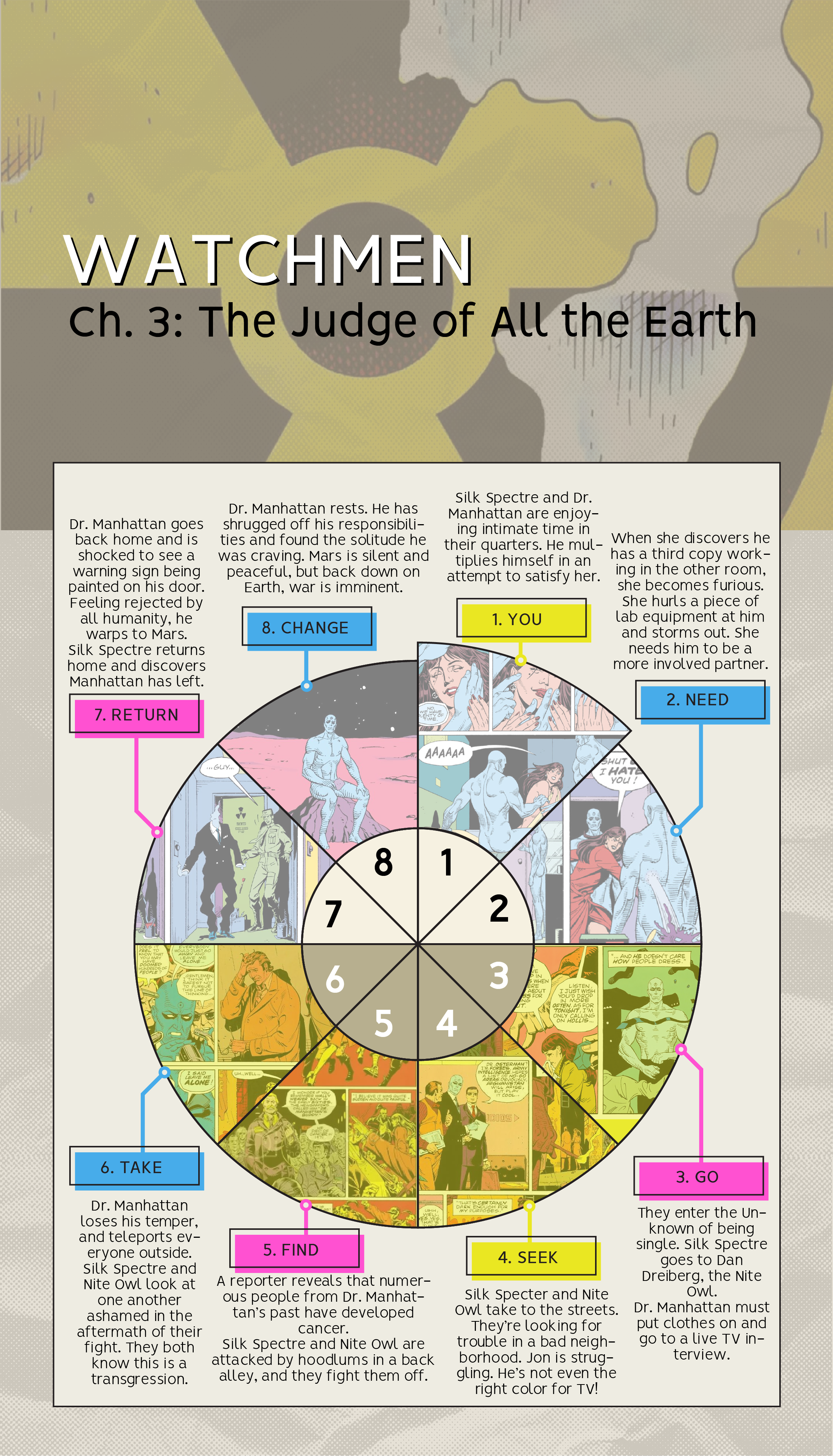
Chapter 3: The Judge of All the Earth
1. YOU:
After an introduction to the corner newspaper stand that will act as a barometer for life in New York and connect us to the people in the streets, this issue focuses on Dr. Manhattan and Laurie’s breakup. Laurie and the Doc are fooling around, when suddenly multiple pairs of blue hands start going to work. Laurie is shocked to realize Jon has copied himself in the hopes of doubling her pleasure. She is disconcerted. She didn’t sign up for an orgy with the Blue Man Group.
2. NEED:
As if that weren’t enough, she explodes when she learns that Jon has a third copy in the lab that was working while they were making love and is still working while they’re fighting. Laurie NEEDS someone that isn’t lost in space. She leaves, furious. Manhattan has been trying to cling to what’s left of his humanity, but his last tether to Earth just stormed out the door. Jon NEEDS someone or something to keep him anchored to humanity now that Laurie has left him.
Forces are mustering against Jon as well. His ex-wife, Janey Slater, is being interviewed about her relationship with him, and how she believes he gave her cancer.
3. GO:
Laurie and Jon both enter the Unknown of being single. She goes to Dan Dreiberg, the Nite Owl. She’s shaken. He offers her a coffee and tries to comfort her, but neither effort settles her nerves.
Jon must put clothes on and go to a live TV interview so that his government handlers can maintain a positive public image for a superhuman in possession of terrifying power.
4. SEEK:
Laurie and Dan take to the streets, and while it’s not explicitly stated, they’re looking for trouble. They wander through a bad neighborhood after being warned against it, and then head down a back alley. The ex-vigilantes are begging for a confrontation.
At the TV station, Jon is struggling. Interacting with normal people is even more difficult for him than interacting with Laurie. The production crew find him unsettling, he’s the wrong color for TV, and he gets hung up on simple parts of conversation, like the preposition, “up”.
5. FIND:
A reporter begins questioning Jon from the crowd. He reveals that numerous people that he spent a lot of time with have developed cancer. The purpose of the interview is beginning to backfire. Jon is appearing more alien and dangerous to the audience.
Meanwhile, Laurie and Dan find exactly what they were looking for: a gang of hoodlums have cornered them. They come to life and brutally fight off their assailants. They will ultimately sleep together in a future issue, but this is their first true infidelity. Vigilante-ing behind Jon’s back is a betrayal of what brought him and Laurie together.
These are both strong examples of how much flexibility there is in what type of event can be a FIND. Jon’s FIND is being blindsided by the negative revelation that he may have caused his ex-wife’s cancer. Laurie’s midpoint is a backalley fistfight. Any event can work, provided it hits a character hard enough that it alters their objectives. For Jon, this is the final straw that will ultimately send him fleeing to Mars. For Laurie, the fight makes her pause and look at what she’s doing. Is she really ready to leave Jon?
6. TAKE:
Jon, crowded by reporters that have emerged from the audience, loses his temper, and teleports everyone on the sound stage outside. The façade of the benevolent protector has been irreparably cracked. He can no longer stand humanity, and they have grown to fear him. He has paid a serious price for disconnecting from Laurie.
In the aftermath of the fight, Laurie and Dan look at one another ashamed. They both know this is a transgression, not just of the Keene Act, but of her commitment to Jon. She leaves Dreiberg, resolving to find a hotel and give her relationship a proper reassessment.
7. RETURN:
Jon goes back home and is shocked to see a radiation warning sign being painted on the door to his quarters. Feeling thoroughly rejected by all humanity, he warps to the Gila Flats test base, RETURNING to the physics experiment gone wrong that originally transformed him. He finds a picture of his ex-wife. The first person he drifted away from. Finally, he teleports from Earth to Mars.
The next day, Laurie RETURNS home and discovers the disproportionate consequences of her choice to abandon Jon. He’s gone, her home is being upended and decontaminated, and the government is furious with her for contributing to their loss of control.
8. CHANGE:
The day’s events dramatically CHANGED Jon. He gave up on humanity, shrugged off the last of his responsibilities and found the solitude he was craving. Mars is silent and peaceful, but back down on Earth, America has lost her living nuclear deterrent. Without Dr. Manhattan, Russia has been emboldened and is moving on Afghanistan. War is imminent.
For Laurie the CHANGE is less dramatic, but it’s a change she effected. Her impatience with his strangeness has caused her to lose Jon.
This chapter’s bookend device is the radioactive sign, a symbol of Dr. Manhattan, his incredible power, and the Cold War arsenal that he once held at bay.
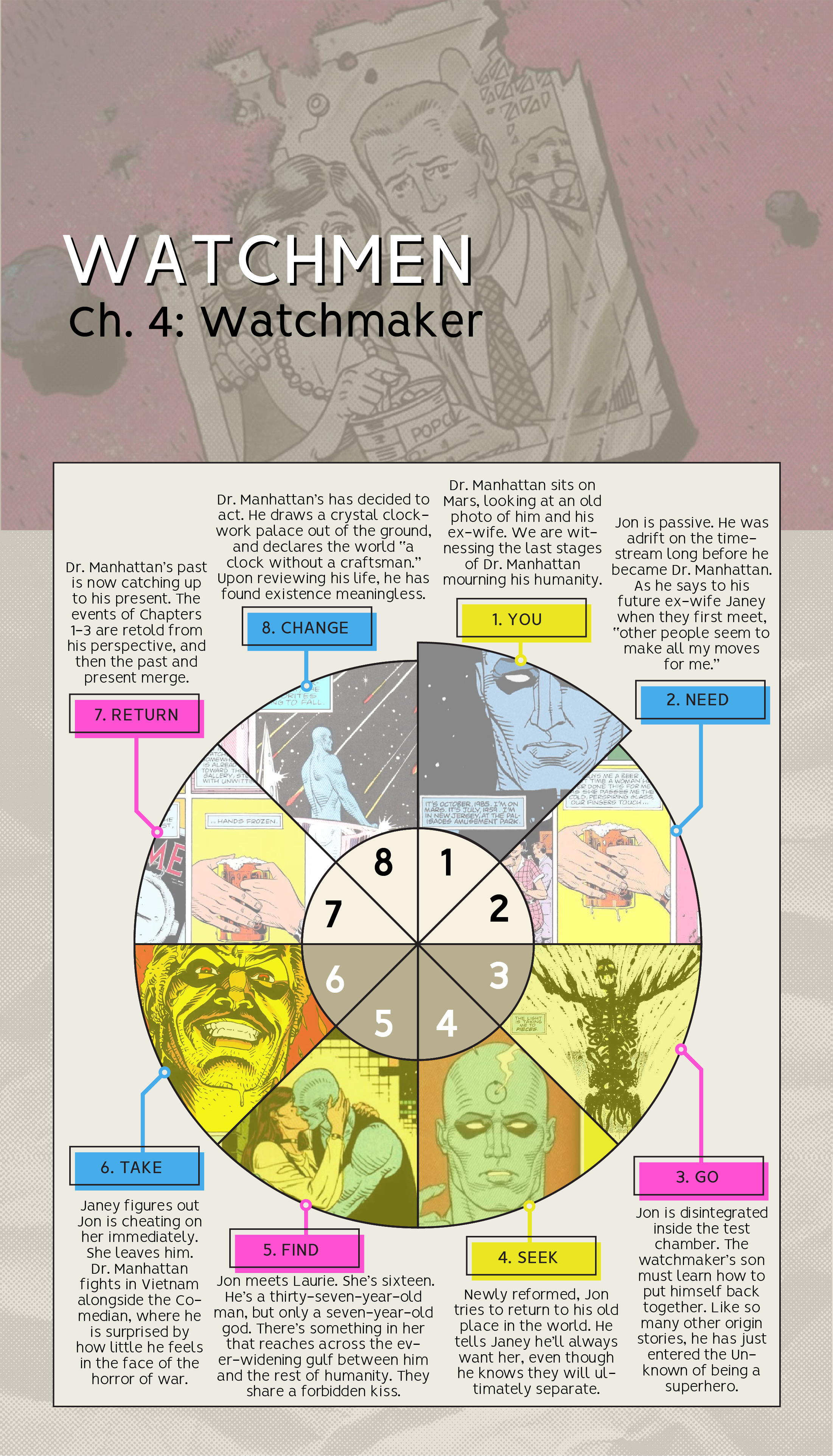
Chapter 4: Watchmaker
1. YOU:
Dr. Manhattan sits on Mars, looking at an old photograph of him and his ex-wife, Janey Slater. He sees it not just in this moment, but also where it will be after he drops it, and simultaneously where it was. We are witnessing the last stages of Dr. Manhattan mourning his humanity. He drops the photo, discarding his past, and looks up to the stars. His narration states he is, “trying to give a name to the force that set (the stars) in motion.” These two opening pages establish Dr. Manhattan’s perception of time: drifting between past, present, and future. They also establish his YOU in the present, but there’s more YOU to establish, because from this point, the doc is going to take inventory of his life.
He remembers being sixteen in 1945. His father, upon learning about Hiroshima, decides to end Jon’s apprenticeship as a watchmaker, and push him toward studying physics. This passivity is an ongoing issue for the character, which leads us to…
2. NEED:
Jon is passive. He was adrift on the timestream long before he became Dr. Manhattan. As he says to Janey when they first meet, “other people seem to make all my moves for me.” He drifts into a romantic relationship with her, due mostly to a man stepping on her watch. After they make love for the first time, he repairs it, but then forgets it inside the experimental test chamber where he is about to have a life-altering accident.
It’s charming when a guy like Forrest Gump drifts through life like a feather on the wind, but for a nearly all-powerful superbeing to deny he has agency is a serious problem. The world that once leaned on him might not survive his existential crisis.
3. GO:
In one of my all time favorite comic panels, Jon is disintegrated inside the test chamber. The watchmaker’s son must learn how to put himself back together. Parts of him begin materializing around the Gila Flats facility. This culminates in his materializing in the cafeteria, blue and naked and all-powerful. Like so many other origin stories, he has just entered the Unknown of being a superhero.
4. SEEK:
Newly reformed, Jon tries to return to his old place in the world. He tells Janey he’ll always want her, even though he knows they will ultimately separate. The government pushes him into being a superhero. They design him a costume and dub him Dr. Manhattan. Soon is swept into crimefighting. Hollis Mason, the original Nite Owl, has retired, and tells Jon he’s the reason why. The strain is building in his relationship with Janey. She can’t comprehend why, when he knew Kennedy was going to be shot, he was unable to stop the assassination.
5. FIND:
At the Crime-Busters meetup (Veidt’s flashback in Chapter 2) Jon meets Laurie. A newly minted superhero, having inherited the Silk Spectre mantle from her mother. She’s sixteen. He’s a thirty-seven-year-old man, but only a seven-year-old god. There’s something in her youth and beauty that reaches across the ever-widening gulf between him and the rest of humanity. They share a forbidden kiss.
6. TAKE:
Janey figures out Jon is cheating on her immediately. She leaves him. Dr. Manhattan fights in Vietnam alongside the Comedian. He breaks up a riot by teleporting hundreds of angry people home, causing some of them to have heart attacks. The Keene act is passed
7. RETURN:
Dr. Manhattan’s past is now catching up to his present. The events of Chapters 1-3 are retold from his perspective.
8. CHANGE:
Dr. Manhattan’s reminiscences are complete. He has decided to act. He hardens the Martian sand, and draws a crystal clockwork palace up out of the ground. But even as he does it, he doubts whether he has chosen its design, or the design was there waiting for him to awaken it. He decides the world is “a clock without a craftsman.” Upon reviewing his life, he has declared existence meaningless. He has shed his humanity fully: first went his mortality, then his love of Janey, then his need for clothes, then his love of Laurie, last his need for a meaningful narrative. Fitting that a storyteller like Alan Moore would consider that the last human trait to fade in a man turned god.
This chapter’s bookend device is the photograph of Janey and Jon.
Epilogue
We’re deep in the Unknown now. Earth is on the verge of nuclear war, and we’re journeying through time and space through the eyes of a godlike superhuman. The pieces of Watchmen’s monumental narrative mechanism are beginning to come together. Chapter 3 is fairly traditional, as far as story structure goes, with both Jon and Laurie enacting complete arcs from their breakup to Jon’s departure. A TV writer would call those an “A” plot and a “B” plot. Multiple plots make it easier to provide both variety and tension for the audience by bouncing between the two of them.
Chapter 4, while doing interesting things with narrative style, uses a common (common because it’s effective!) device for integrating flashbacks into the primary story. The flashback is bracketed by Dr. Manhattan on Mars in the present, and his review of the events evokes a change in him; he is transformed after revisiting his past. We will see similar uses of this device in Chapters 6 and 9. An important lesson to take away from Chapter 4 is that it gives details about a character after creating a demand for more information about that character. Dr. Manhattan has a cool origin story, but it’s only after he’s put the world on the verge of nuclear war that Watchmen spends an entire issue explaining his origins to a now-primed reader.
Next time: the love letter to structure that is Fearful Symmetry.